The DeMarker indicator: what DeM(14) really tells you
The DeMarker compares the recent highs buyers achieved against the recent lows sellers achieved, scaled between 0 and 1. Readings below ~0.30 mean directional demand is washed out; above ~0.70, stretched. Its honest use is as a condition, not a signal: a level worth buying becomes more trustworthy when weekly DeM is under 0.30, because the sellers who would break it are exhausted.
What it measures, mechanically
DeM(14) looks at each bar’s high versus the prior high and low versus the prior low, accumulates the buying excess and selling excess over 14 periods, and expresses buying as a share of the total. A market grinding out lower highs and lower lows pushes the reading toward zero, not because price is "cheap", but because the demand side has stopped showing up. That distinction is why it pairs so naturally with value zones: it times exhaustion, while the zone supplies the reason to care.
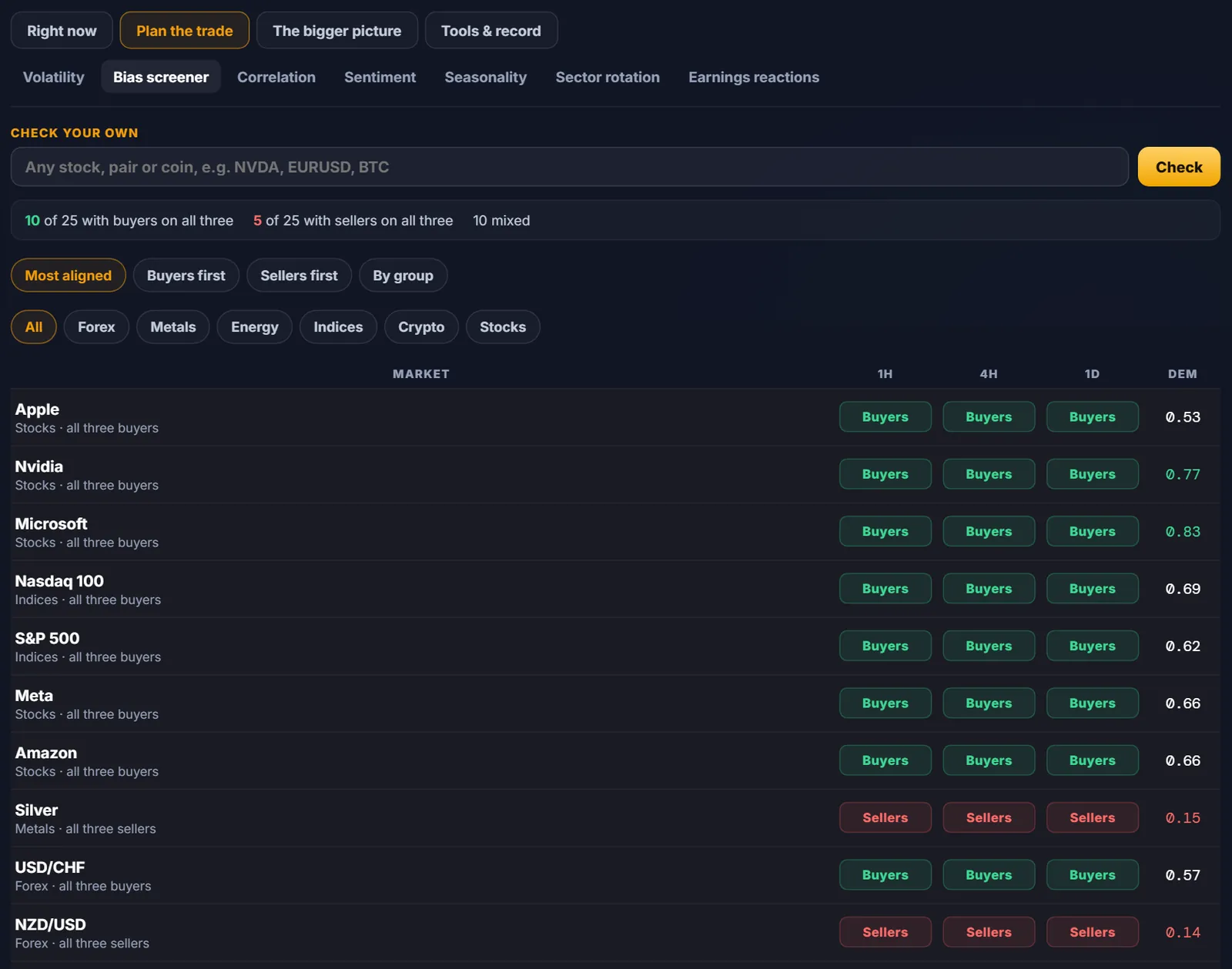
It is bounded, so it behaves consistently across instruments, a 0.25 on a forex pair means the same kind of exhaustion as a 0.25 on a stock, which is precisely why the desk shows the same DeM(14) column across every tab.
The two readings that matter, and the path between them
Below 0.30 at a level you already wanted is the combination that earns an entry: washed-out sellers meeting a structural reason to bounce. On the weekly timeframe this is the desk’s condition for trusting a 200-week zone touch; on the daily it times swing pullbacks within an intact trend.
The path matters as much as the number. A DeM at 0.29 and still falling is a knife; 0.29 after basing and turning up is a trigger arming. And a high reading is not an automatic short, in a strong trend DeM can sit stretched for weeks. Extended momentum is a reason to stop chasing, not a reason to fade.
What it cannot do
No oscillator carries information about where price is, only about how it got there. DeM below 0.30 in a broken downtrend just means the collapse is orderly. This is why the desk never publishes "DeM is oversold" as a setup: the setup is the level, the structure and the risk; DeM is one vote on timing. If you take one thing from this page: location first, oscillator second, and a stop regardless, the stop-loss guide is the other half of this page.
This week’s setups are already mapped
Every Sunday before the open: analysed swing setups across stocks, forex and crypto with the exact entry, stop and target, plus the live dashboard, three letters a week, the TradingView indicator suite and the masterclass library.
Get this week’s setups →118 trades · 60 losers shown · +50.5R see the full record →
FAQ
DeMarker vs RSI, what is the difference?
RSI measures the magnitude of closes up versus down; DeMarker measures whether buyers and sellers are extending the range (new highs/new lows). In practice they often agree, but DeM is more sensitive to genuine exhaustion of directional attempts, which suits timing entries at pre-chosen levels.
What settings should I use?
The standard 14 periods. The edge is not in tuning the lookback, it is in applying one setting consistently enough that you learn what its extremes look like on your timeframe.
Which timeframe is right?
Match it to the decision. Weekly DeM for accumulation-zone timing (slow, rare, meaningful), daily DeM for swing entries within a trend. Reading a 5-minute DeM for a multi-week trade is astrology.
Can I trade DeMarker signals on their own?
No. Backtests of any oscillator traded blind tend to bleed slowly in trends. It filters and times decisions you already have a structural reason to make, that is the whole job.