How to Choose a Trading Service (2026): 10 Checks Before You Pay
The short version: pay only for a service where you can verify the levels were published before the move, every idea carries a stop, the reasoning is shown, losers are discussed as openly as winners, nothing promises profit, and you can cancel in one click. Everything else on the sales page is decoration.
1. Levels published before the move, not claimed after
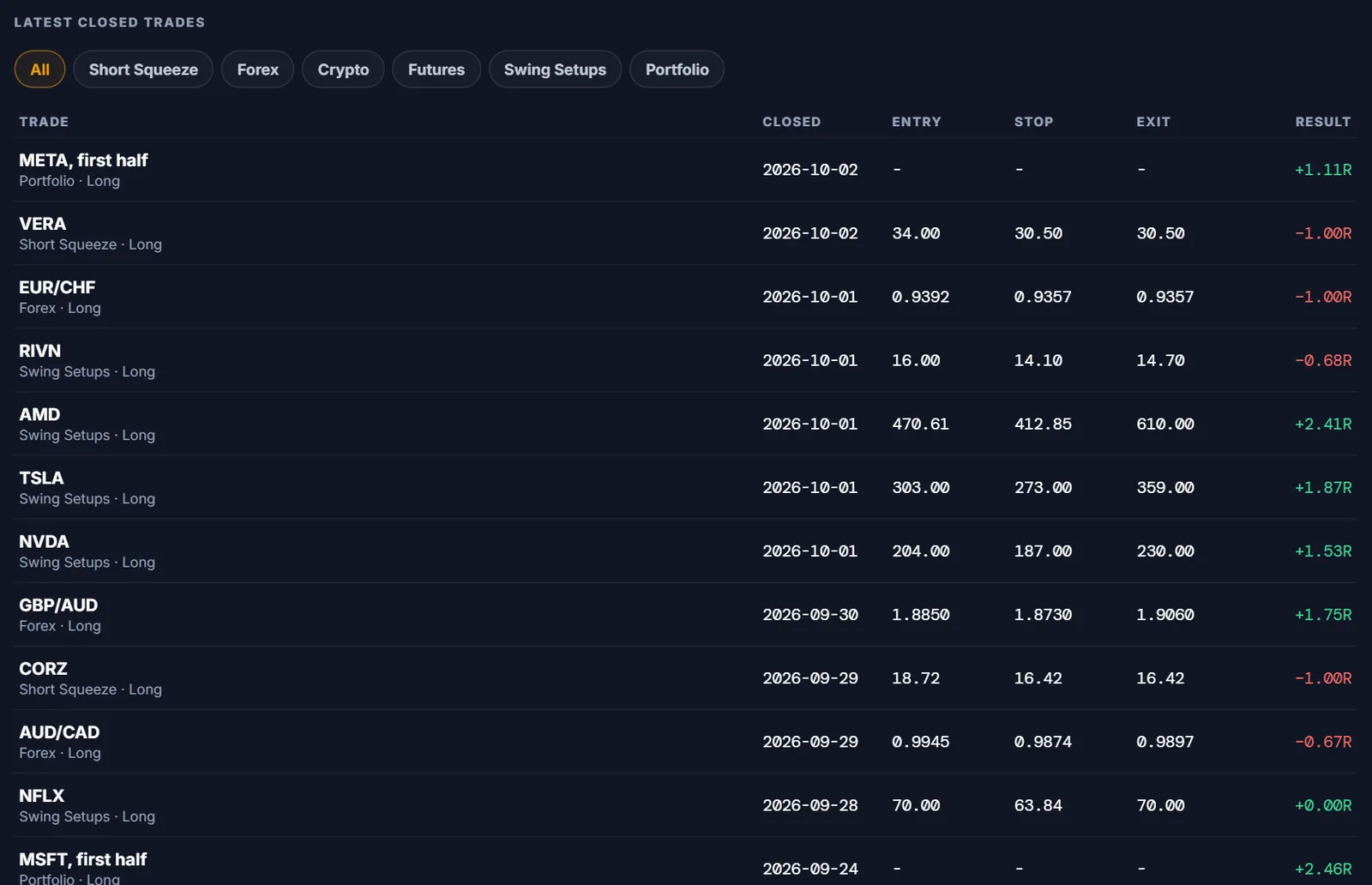
The single most important check. Anyone can screenshot a winner after the fact; almost nobody fakes a dated, timestamped level published before the market opened. A trustworthy service has a visible trail: dated posts, a dashboard with a published "updated" date, levels that existed before Monday's open.
2. A stop-loss on every single idea
An entry without an invalidation level is not a trade idea, it's a lottery ticket with your money. The stop is where the analysis admits it was wrong; a service that won't publish one is refusing to ever be wrong.
3. Reasoning you can verify on the chart yourself
"Buy X at Y" cannot be checked. "X is above its rising 200-week average, momentum has reset from oversold, and Y is the invalidation low" can be, open the chart and look. Verifiable reasoning is also the only kind you can learn from, which is the only way a subscription ever stops being a permanent expense.
4. Covers the markets you actually trade
A brilliant options-flow room is useless to a forex swing trader. Match the service's coverage, instruments and timeframe, to your own trading before anything else about it matters.
5. Talks about losing trades openly
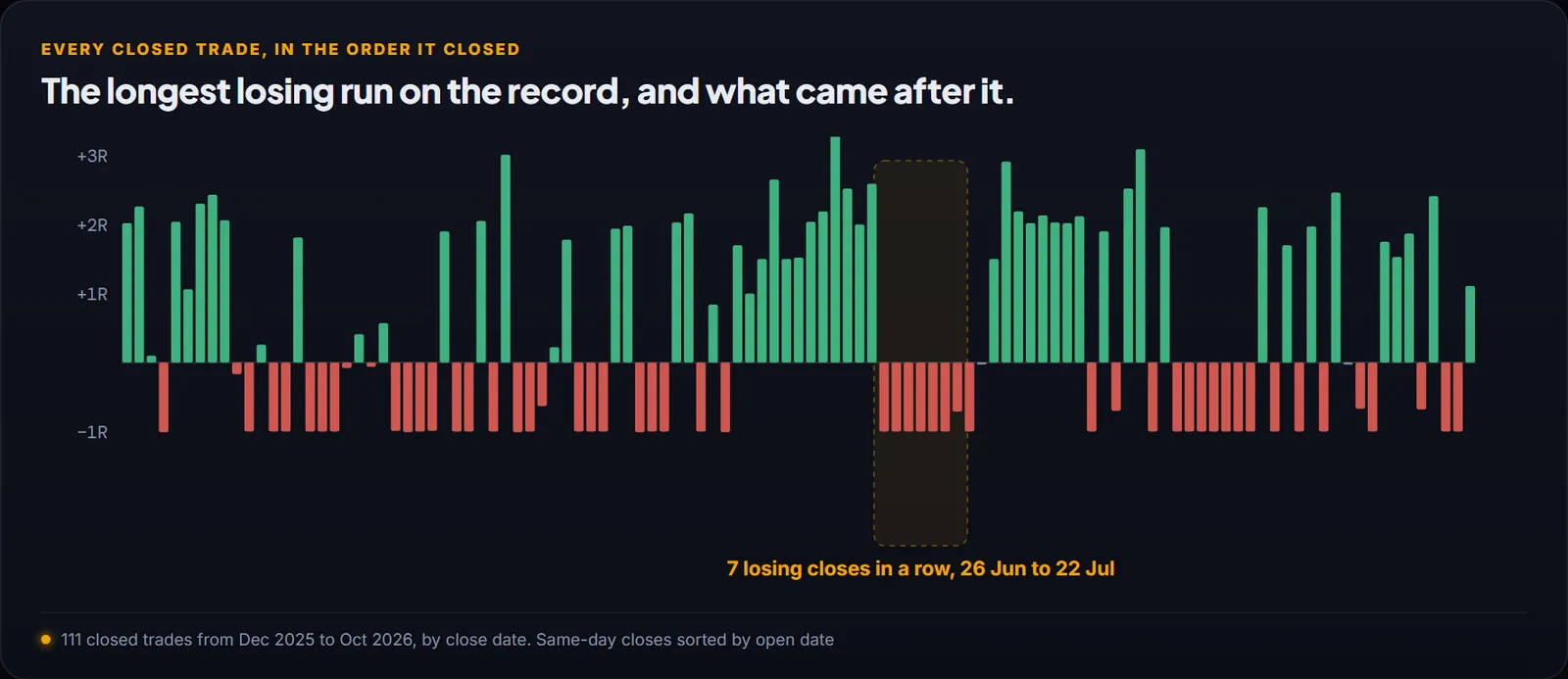
Every real strategy loses regularly. A service's handling of losers tells you more than its winners: are stopped trades acknowledged, post-mortemed, and left visible, or do they quietly vanish from the feed?
6. No profit promises or income claims
"Make $500/day", "quit your job", "47% win rate", these aren't just tacky, they're the signature of services whose real product is the subscription, not the analysis. Honest services frame themselves as education, carry risk disclaimers, and never guarantee outcomes, because outcomes can't be guaranteed.
7. Cancel-anytime without hoops
Confidence in a product shows up in its exit door. One-click cancellation through a real billing platform means the service expects to re-earn you monthly; "DM us to cancel", long lock-ins and no-refund terms mean retention is doing the work the content should.
8. Education included, so your skill compounds
The best subscription is one you'll eventually need less. Look for teaching alongside the calls, letters, breakdowns, a stated method you can internalise. Ideas pay this week; understanding pays every week after.
9. Price that passes the per-day sanity test
Divide the monthly price by 30 and ask what you're getting per market day. Cost doesn't predict quality in this category, some $150/month rooms publish less analysis than a good $14/month letter. Judge the daily rate against what you can actually verify from checks 1–8.
10. Something public you can judge before paying
Free trials aren't the only honest preview, a public sample letter, real product screenshots, or a free tier all let you judge quality before money moves. What matters is that something real is inspectable in advance.
How the Trade Desk honestly scores
We run a weekly analysis desk, so grade us with our own rubric, including where we lose points:
| Check | Score | The honest detail |
|---|---|---|
| 1. Levels before the move | Pass | The week's setups publish every Sunday before the open, with a visible updated date and a live trigger watch through the week. |
| 2. Stop on every idea | Pass | Every setup carries entry, stop and scale-out targets; stops are defined before entry and tracked live. |
| 3. Verifiable reasoning | Pass | Every setup shows its 3-Gate analysis (Trend · Momentum · Risk), re-drawable on any free chart. |
| 4. Market coverage | Partial | Large-cap US stocks, forex majors and major crypto on swing timeframes. Not for intraday scalpers or options/futures specialists. |
| 5. Losses discussed | Pass | Stopped trades stay on the board, marked stopped, and the letters post-mortem them. |
| 6. No profit promises | Pass | Educational analysis only; risk disclaimers throughout; no income claims anywhere. |
| 7. Cancel anytime | Pass | One click through Substack. $29/mo, or $199/yr on the 20% launch offer ($249 after). |
| 8. Education included | Pass | Three letters a week, a masterclass library and a named method (the 3-Gate System). |
| 9. Per-day sanity | Pass | About 95¢ a day monthly, 68¢ a day annual, judge it against the public sample and the track record. |
| 10. Public preview | Partial | No free trial. Instead: a complete public sample letter and real product screenshots on the landing page. |
Eight passes, two partials, the partials are deliberate trade-offs (weekly swing focus; low price instead of a trial), but you should know them before paying.
Five questions to email any service before you pay
1. Can you link three ideas published before the move, including one that lost?
2. Does every idea include a numeric stop at publication time?
3. What exactly is your method, in one paragraph?
4. How do I cancel, and how long does it take?
5. What should a realistic first year following your service look like?
An honest service answers all five in one reply. Evasion on any of them is your answer.
Judge us with the checklist
Read the free sample letter, look at the real screenshots on the landing page, then decide. Every Sunday: analysed setups across stocks, forex and crypto with exact levels and reasoning, $29/mo, or $199/yr on the 20% launch offer, cancel anytime.
Get this week's setups →FAQ
Are trade alert services worth it?
Only the ones that make you better without them: levels verifiable before the move, reasoning you can learn from. Fail either test and it's entertainment, not education.
How much should a trading service cost?
Anywhere from ~$10/mo newsletters to $200+/mo rooms, price doesn't predict quality. Do the per-day math and judge it against what you can verify publicly.
Can I trust win-rate claims?
Not without timestamps. After-the-fact screenshots prove nothing; pre-published, dated levels prove everything.
What's a realistic outcome?
A better process, planned entries, a stop on every trade, growing independence. Not guaranteed profits; trading involves substantial risk of loss.
Who is the Trade Desk NOT for?
Intraday scalpers, options/futures specialists, and anyone who wants profit promises. It's weekly swing analysis across stocks, forex and crypto, educational only.