How to find short squeeze stocks, a method, not a tip list
A squeeze candidate needs three things at once: crowded shorts, a reason they are wrong, and a trigger that proves it. In practice that means high short interest relative to float, several days-to-cover, and a technical reclaim that forces covering, entered with a hard stop, because most squeeze setups fail and the method only works when the failures are cheap.
The screen: crowded and vulnerable
Short interest above roughly 15–20% of float marks a crowded trade; the exact cutoff matters less than the idea that someone is trapped if price rises. Days-to-cover above ~3 (short interest divided by average daily volume) measures the exit door: the higher it is, the longer forced buying lasts. Both figures are published, Broker-dealers report short positions to FINRA twice a month under Rule 4560, FINRA publishes the figures on the 7th business day after each settlement date, and most data portals surface them free.
Crowded alone is not enough; heavily shorted companies are often shorted for excellent reasons. The list gets interesting where the short case is stale, improving results, a survived catastrophe, sector momentum returning, while positioning has not adjusted.
The trigger: make the shorts prove it
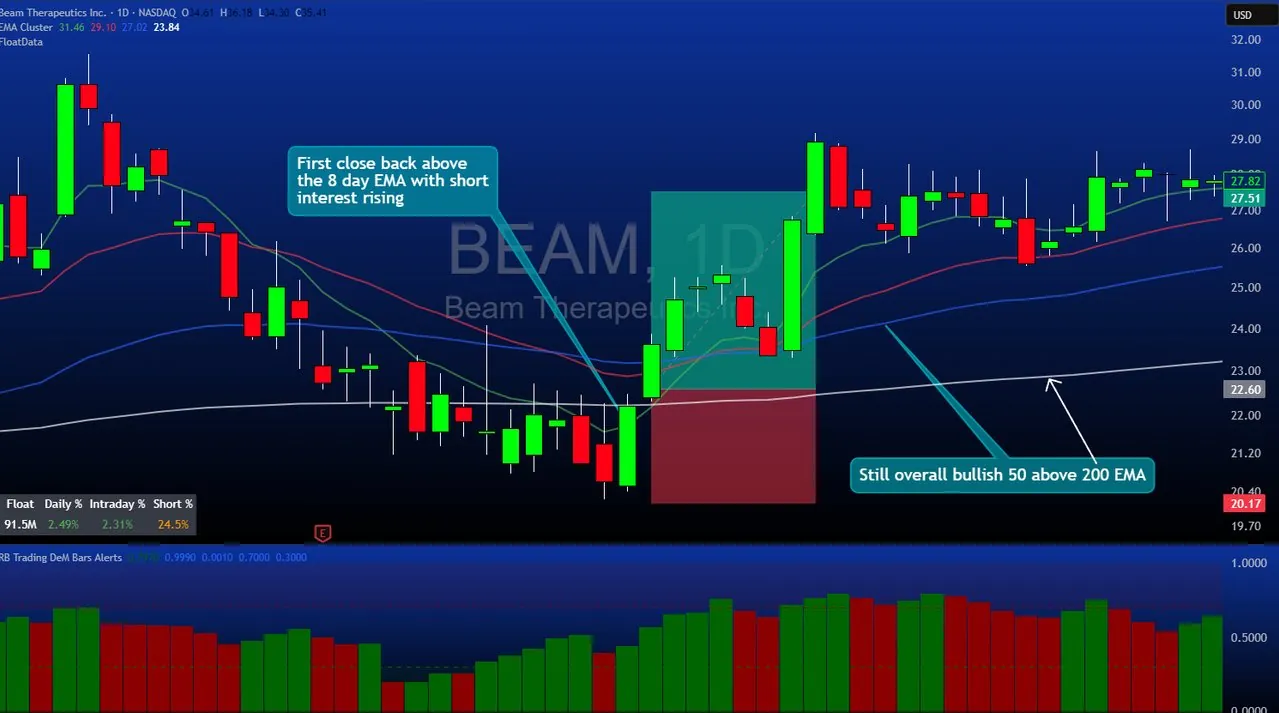
Squeezes start when holding the short becomes painful, and pain shows up on the chart before it shows in filings. The desk’s preferred shapes: the first daily close back above a short-term average (like the 8-day EMA) with short interest still rising, a trend-break candle that also reclaims that average, or a higher-low structure forming while the crowd stays short. The common thread is a defined line in the sand, which is also your stop.
Entering before a trigger is just being long a heavily shorted stock, which is how squeeze traders donate money. The trigger is what converts "cheap and hated" into "shorts are being forced to act".
Why most squeeze picks fail, and why the method still pays
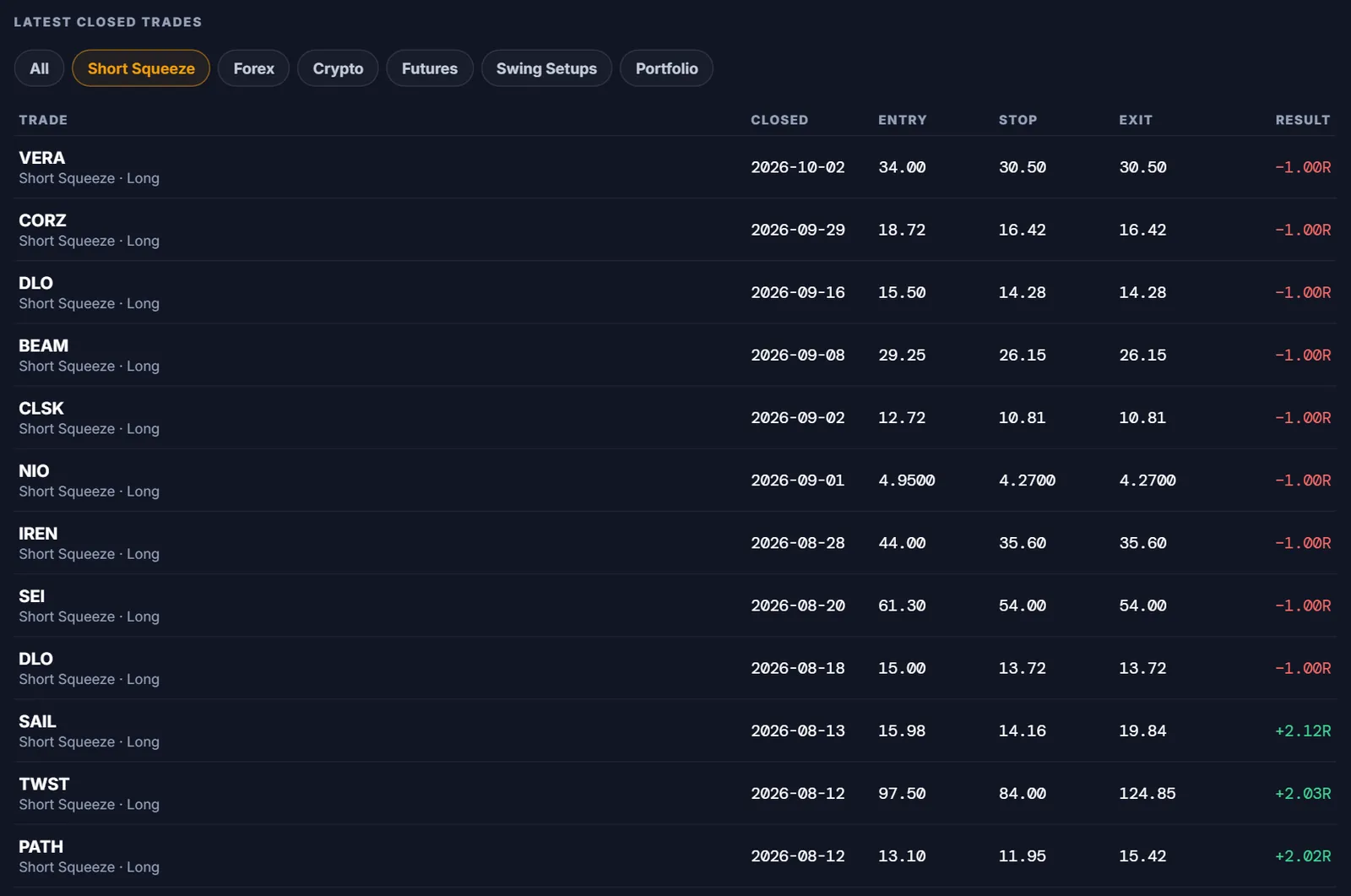
Honest numbers from the published record: the squeeze bucket wins roughly four trades in ten. The method survives because the maths does not need a majority, losers are capped at the stop (−1R), winners are allowed to run to 2R and beyond, and at that payoff a sub-50% hit rate compounds positively. The R-multiple guide works through that arithmetic.
The corollary: any squeeze approach without a hard stop is a different, much worse strategy. And chasing, buying after the vertical move you were hoping for, inverts the risk-reward entirely. If the trigger is more than a couple of ATRs behind, the trade is gone; there is always another crowded chart.
A squeeze from the record, start to finish: TWST +2.03R
Twist Bioscience ran the full playbook this screen teaches. It appeared on the published watchlist on 19 July 2026 as a break-above setup: entry on a break of $97.50, stop $84.00, target $124.85, levels stated in advance, on the record. The break came on 3 August; the trade filled at $97.50 and hit the published target on 12 August. Result: (124.85 − 97.50) ÷ (97.50 − 84.00) = +2.03R.
Two things worth copying from it. The trigger did the waiting, the setup sat on the watchlist for two weeks without a position, because a squeeze candidate is not a trade until the level breaks. And the target was pre-committed, so the exit was mechanical when the crowd was at its loudest. The same discipline runs the other way when a squeeze fails: capped at the stop, logged, published, see every loss on the record.
This week’s setups are already mapped
Every Sunday before the open: analysed swing setups across stocks, forex and crypto with the exact entry, stop and target, plus the live dashboard, three letters a week, the TradingView indicator suite and the masterclass library.
Get this week’s setups →118 trades · 60 losers shown · +50.5R see the full record →
FAQ
What short interest percentage counts as high?
Above ~15% of float is elevated and above 25% is genuinely crowded, but treat thresholds as context, not rules. A 12% name with 6 days-to-cover can squeeze harder than a 30% name that trades its float daily.
Where can I get short interest data free?
US exchange short-interest reports (published twice monthly via FINRA and the exchanges) and most large finance portals carry the headline figures. The data is delayed by design, which is fine, because the method trades the chart trigger, not the filing date.
Why do most short squeeze trades fail?
Because the base case for a heavily shorted stock is that the shorts are right. The method makes money not by picking winners often, but by capping every failure at one planned risk unit while letting the occasional forced-covering run pay for the rest.
Is squeeze trading investing?
No. It is a defined-risk trade on positioning, usually lasting days to weeks. If you find yourself holding a failed squeeze because you now "believe in the company", two mistakes are compounding.