The 200-week moving average: an accumulation strategy
The 200-week average is where long bull cycles in quality names have historically paused, not died, which makes it a value zone for slow accumulation rather than a trading signal. The workable rules: buy interest only within about one weekly ATR of the 200-week EMA (either side), never chase beyond two ATRs above it, treat two ATRs below as a broken trend rather than a bargain, and require the long-term structure (50-week above 200-week) to still be intact.
Why the 200-week, and why EMA
Two hundred weekly closes is close to four years of price, a full economic mini-cycle. When a liquid, profitable company trades back into that neighbourhood, one of two things is true: the market is offering a cycle-low entry, or the business has genuinely broken. The entire strategy is a framework for telling those apart and sizing for being wrong.
The exponential version reacts slightly faster than the simple average, which matters at this timescale, a 200-week SMA can lag a structural change by months. Either works if applied consistently; consistency is the point.
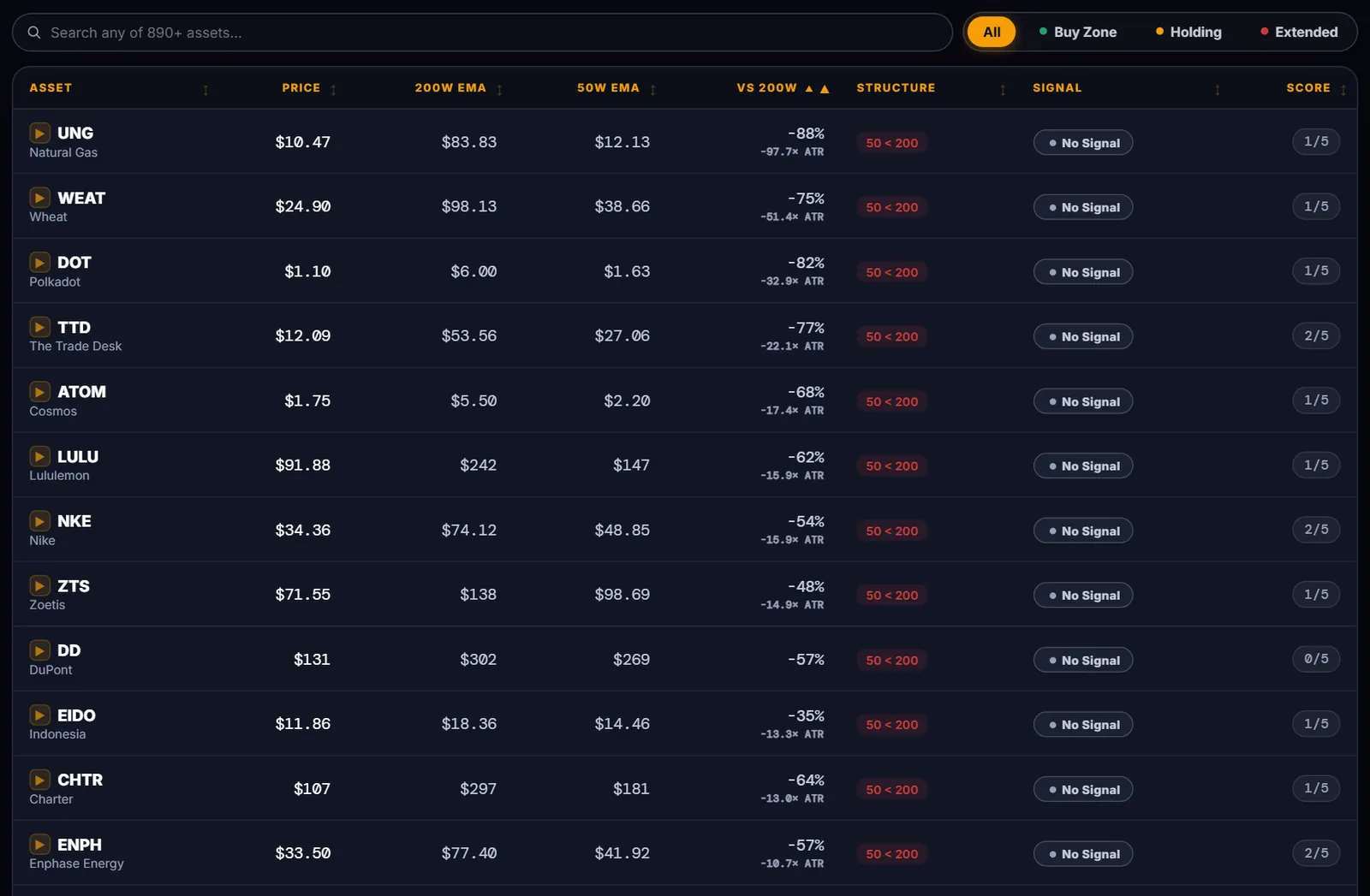
The zone, and both of its edges
Distance is measured in weekly ATR, not percent, so volatile names get proportionally wider zones. Within ±1 ATR of the 200-week EMA is the buy zone, and the symmetry matters. Half an ATR below the average is the same quality of entry as half an ATR above; being under the line is not automatically a broken chart.
The edges are where discipline lives. More than ~2 ATR above the zone is chasing: the value entry is gone and buying there converts an accumulation plan into momentum trading with the wrong tools. More than ~2 ATR below is not a deeper bargain, it is the market telling you the long trend may be over, and averaging down into that is how accumulation strategies destroy accounts. Cheapness helps only while the structure holds, which is why the 50-week-above-200-week check gates everything.
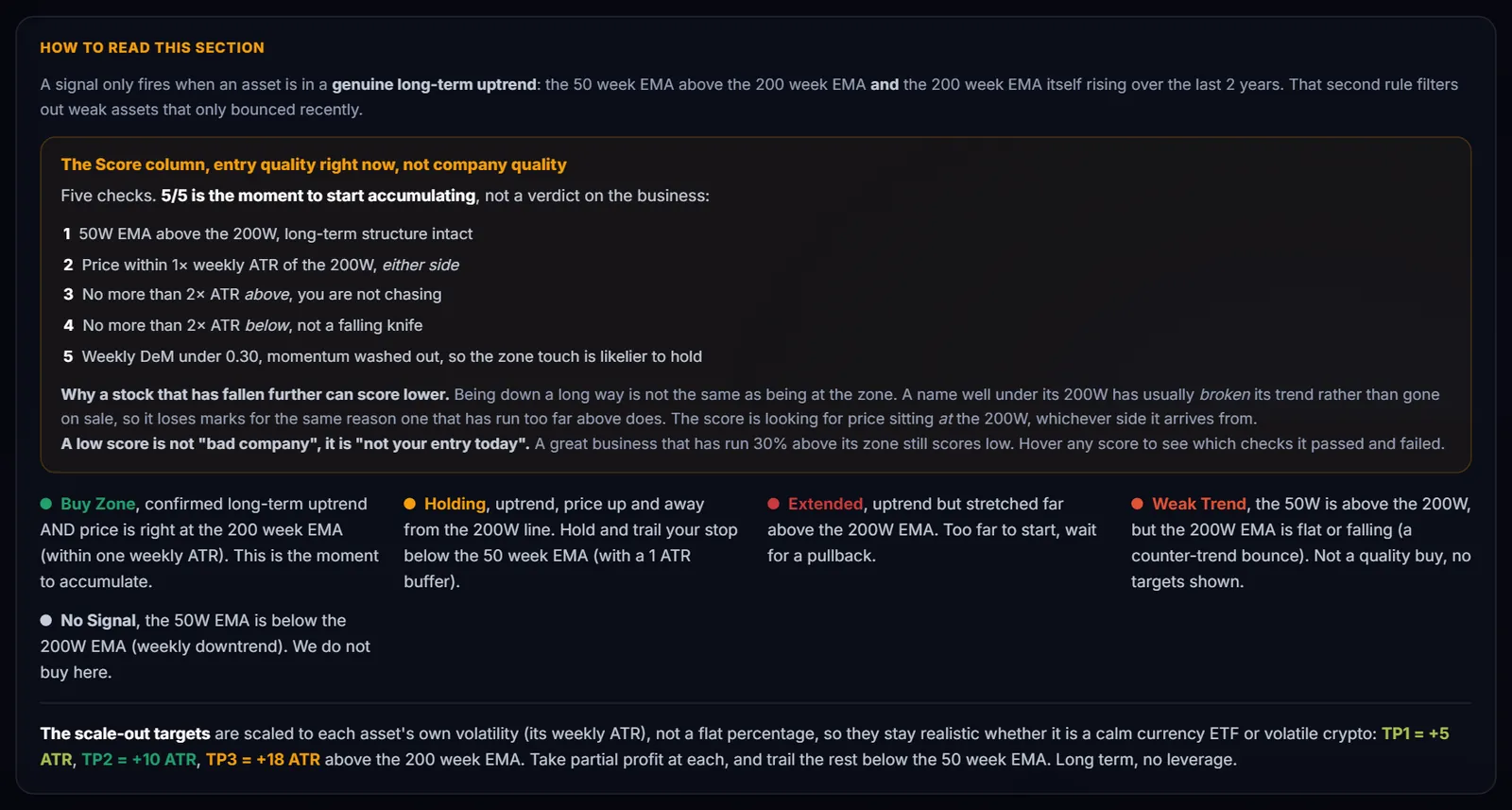
Timing and exits
Zone touches without washed-out momentum tend to dip further before turning. The desk uses the weekly DeMarker for this: a reading below 0.30 says selling pressure is exhausted, which makes a zone touch materially more likely to hold, the DeM guide covers the mechanics. Splitting the entry (half at the zone, half lower) is the practical alternative to pretending you can pick the exact low.
Exits are scale-outs at ATR-scaled distances above the zone rather than a single all-out target, because the whole premise is a multi-quarter recovery. No leverage, ever, at this timescale: the strategy’s tolerance for being early is its strength, and leverage deletes it. This is also the one context where holding through earnings can be defensible, size is set for events from the start.
This week’s setups are already mapped
Every Sunday before the open: analysed swing setups across stocks, forex and crypto with the exact entry, stop and target, plus the live dashboard, three letters a week, the TradingView indicator suite and the masterclass library.
Get this week’s setups →118 trades · 60 losers shown · +50.5R see the full record →
FAQ
Why the 200-week average instead of the 200-day?
Different tool for a different job. The 200-day tracks the medium trend and gets visited routinely; the 200-week marks cycle-scale value and might be touched once in several years. Swing trades key off daily structure, accumulation keys off the weekly.
Does the 200-week strategy work on any stock?
No, it assumes the company survives to recover, so it belongs on liquid, profitable, established names. Applied to speculative stocks it becomes catching falling knives with extra steps. Quality filter first, chart second.
How often does it give signals?
Rarely, by design. In a strong bull market almost nothing quality trades near its 200-week. The correct behaviour is patience, not loosening the rules until something qualifies.
Does it apply to crypto?
The majors have respected the 200-week zone across previous cycles, with the caveat of far wider ATRs and the possibility that any crypto asset simply does not recover. Same rules, smaller size, no leverage, and only assets you would hold through a full bear market.