How to set a stop-loss on a swing trade
The stop goes where the trade idea is invalid, then position size is calculated from that distance, never the reverse. Decide the invalidation price, decide what one unit of risk (1R) is in money, and divide: size = risk ÷ (entry − stop). Across the 118 closed trades in the published record, all 60 losers were held to −1.01R or better, the entire edge rests on that discipline, not on picking winners.
Invalidation, not pain
A stop is a factual statement: "below this price, the reason I entered no longer exists." For a breakout, that is back inside the base. For a pullback entry in a trend, it is below the structure that defines the trend. What a stop must never be is a pain threshold, "I can afford to lose $200" produces stops inside random noise, which is how traders get the direction right and still lose.
The practical test: if price hit your stop, would you want to re-short/re-long the other way, or at least agree the setup failed? If the honest answer is "no, I’d still believe in it", the stop is in the wrong place, and the position is probably too big for the right place.
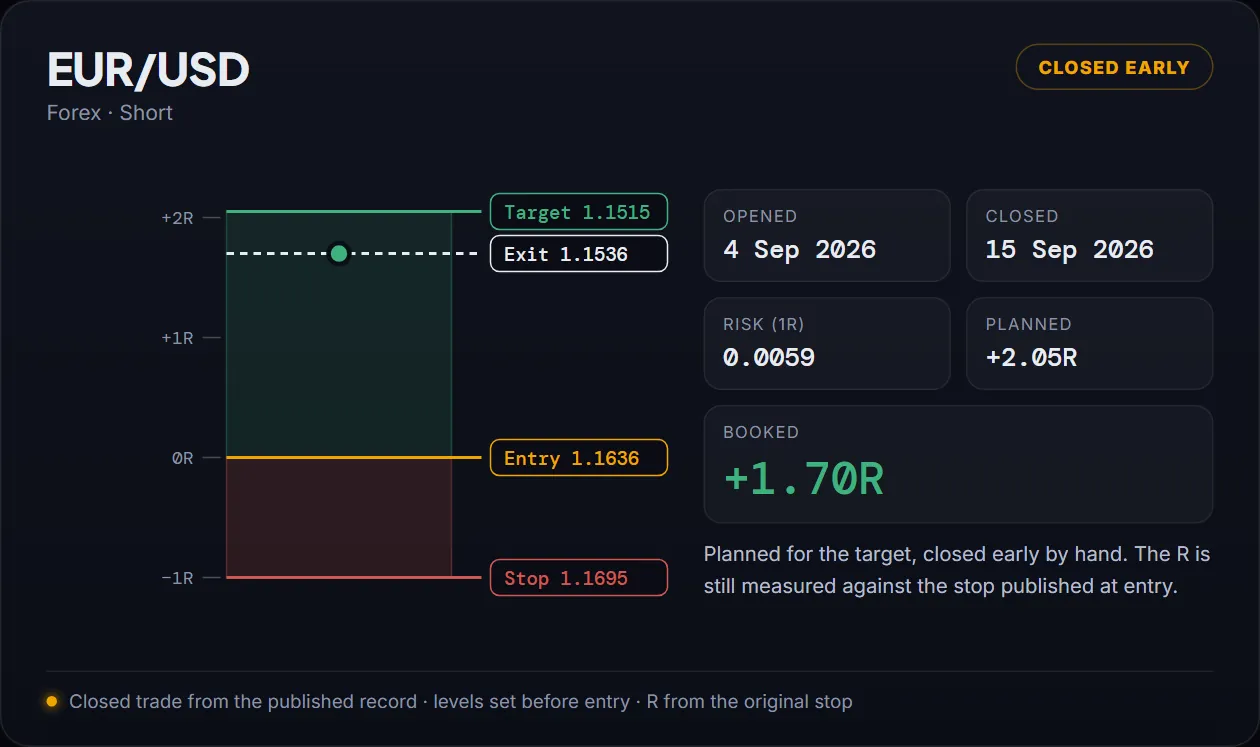
The 1R sizing formula
Fix your risk unit first, commonly 0.5–2% of the account. Then: position size = R in money ÷ stop distance. A $10,000 account risking 1% has R = $100; an entry at $50 with a stop at $46 (distance $4) means 25 shares. The stop distance being wide is not a problem, it just means fewer shares. Refusing to size down and tightening the stop into noise instead is the classic inversion, and it converts a good level into a coin-flip.
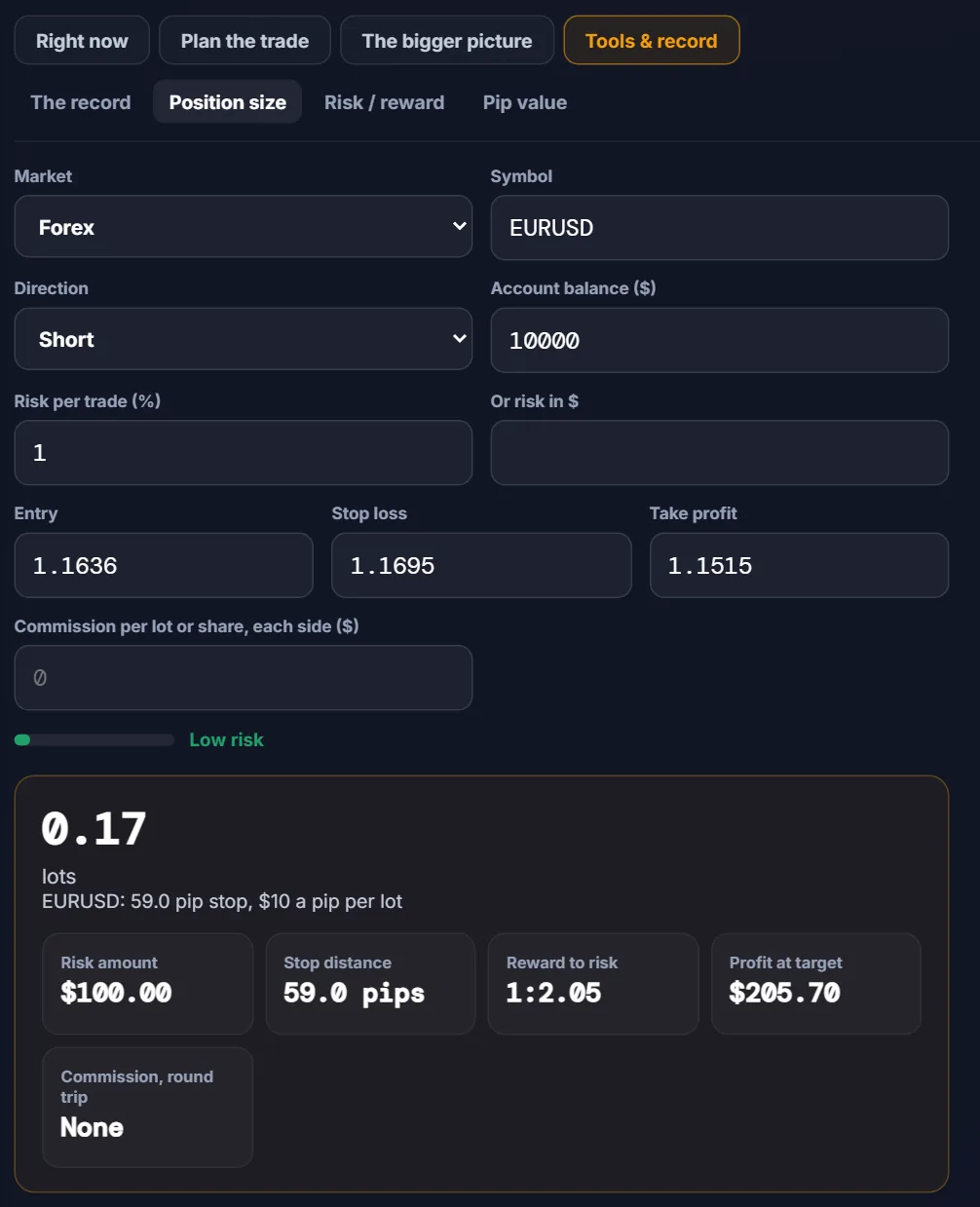
This is what makes results comparable in R-multiples: every trade risks one unit, so a +2R winner genuinely pays for two losers regardless of ticker or price.
Hard stops, moving stops, and the one exception
Keep the stop in the market, not in your head. Mental stops fail exactly when they matter, in fast moves, while you negotiate with yourself. The evidence for hard stops is the shape of the published record: every loss is capped close to −1R, so no single trade can undo a run of winners. With the winners larger than the losers, a win rate under half still finishes ahead, and that margin is the stop discipline. The record page carries the current figures and updates every Sunday.
Stops move in one direction only: toward the trade. To break-even after structure confirms, then trailing under new structure if the plan says so. Widening a stop is re-entering a losing trade at the worst possible moment with extra size. The one genuine exception to hard stops is event risk, an earnings gap ignores your stop entirely, which is a sizing-and-calendar problem, not a stop-placement one.
The worst loss on the whole record: −1.01R
Here is what this discipline buys, from a real published trade. GBP/CAD, long from 1.85956, stop at 1.85263 to 16 April 2026. Price came straight for the level and the trade was stopped the same day at 1.85255, a fill one hundredth of an R past the stop: −1.01R. That slippage of 0.00008 on the fill is the entire margin by which the worst trade in 118 published trades exceeded its planned risk.
No widening the stop, no "give it room", no averaging down. The plan risked about 1% of the account and it cost about 1%, then the next trade was taken, and the record absorbed the loss without drama: it stands at +50.5R with 60 losers in it, every one published. Sizing so a stop equals 1% is arithmetic, not judgement, the free position size calculator does it from your entry and stop.
This week’s setups are already mapped
Every Sunday before the open: analysed swing setups across stocks, forex and crypto with the exact entry, stop and target, plus the live dashboard, three letters a week, the TradingView indicator suite and the masterclass library.
Get this week’s setups →118 trades · 60 losers shown · +50.5R see the full record →
FAQ
Percent stop, ATR stop or structure stop?
Structure decides where; ATR sanity-checks it (a stop inside one daily ATR of entry will be hit by noise); percent is only a sizing consequence. A fixed "2% price stop" on every trade ignores both volatility and structure, it is a rule for people who want rules more than results.
Is stop hunting real?
Clusters of obvious stops do attract liquidity probes, especially in forex. The defence is not skipping stops, it is placing them beyond the obvious level plus a volatility buffer, and sizing so the wider stop is affordable.
How tight is too tight?
Inside the instrument’s normal noise. If the stop distance is less than roughly one daily ATR on a multi-day swing trade, you are betting on a straight line that markets rarely draw. Tight stops feel disciplined and bleed accounts.
Should winners ever be exited before the target?
By plan, yes, scale-outs, trailing after structure, or event risk approaching. By feeling, no. The record’s average winner (+1.77R) is nearly double its average loser precisely because winners were allowed to finish.